History of the 13 Colonies and the laws & taxes that sparked rebellion against the British
The definition and purpose of the Proclamation of 1763 and the cry of "No taxation without representation!"
Proclamation of 1763 Summary and Definition
British Proclamation of 1763 Summary and Definition: The Royal Proclamation of 1763 was issued October 7, 1763, by King George III following Great Britain's acquisition of French territory in North America following the end of the French and Indian Wars with the Peace of Paris which concluded the Seven Years' War in Europe and the French Indian War in America. The Royal Proclamation of 1763 was designed to calm the fears of Native Indians by halting the westward expansion by colonists whilst expanding the lucrative fur trade. Refer to Royal Proclamation of 1763 for the actual words and text.

French Indian Wars
Royal Proclamation of 1763 - The Fur Trade
The British had a financial reason for the Royal Proclamation of 1763. Their victory in the French and Indian Wars enabled them to monopolize the highly lucrative fur trade, also refer to Triangular Trade. They wanted to improve and expand trade further which involved the Native American Indians who lived on the frontier. The fight to monopolize the fur trade in French territory had led to the the bloody conflict known as the Beaver Wars in 1640 - 1701 against the Iroquois Confederacy.
Royal Proclamation of 1763 - The Proclamation Line
The Royal Proclamation of 1763 at the end of the French and Indian War established the controversial Proclamation Line along the Appalachian Mountains safeguarding Indian lands and territories and repaying the Native American Indians who helped the British during the war. Many of the American Indians, primarily in the Great Lakes region, had close relationships with France and were appalled to find that they were now under British control. Pontiac's Rebellion during the Pontiac War (1763–66) was an unsuccessful effort by Native American Indians to prevent Great Britain from occupying the land previously claimed by France and this hastened the implementation of the Royal Proclamation of 1763. The Royal Proclamation of 1763 was an attempt by the British crown to separate white settlements from Indian country. The colonists perceived that the Royal Proclamation of 1763 clearly demonstrated that the British King was on the side of the Indians to the detriment of the colonists.
Royal Proclamation of 1763 - Manning the Proclamation Line
The introduction of the massive boundary, which was the Proclamation Line, would require the establishment and the manning of posts along the border. A costly venture which the British administration argued was for the defence of the colonists. It was therefore deemed that the costs should be paid for by the colonies. From the perspective of the colonists this amounted to a tax to pay for a boundary to lands that was against the interests of the British Colonies.
Proclamation of 1763 - Proclamation Line Map
Map: The Royal Proclamation of 1763 resulted in a massive border, or Boundary Line, referred to as the Proclamation Line, which is shown on the Proclamation Line Map. The Proclamation Line between the British colonies on the Atlantic coast of America and American Indian lands called the Indian Reserve ran west of the Appalachian Mountains and south of Hudson Bay to Florida. The Proclamation Line was not intended to be a permanent boundary between the lands of settlers and Indians, but rather a temporary boundary which could be extended further west in an orderly, lawful fashion. Reaction of the Colonists to the Proclamation of 1763
The British colonists vehemently resented the Royal Proclamation of 1763 and the introduction of the concept of the Proclamation Line. Prominent American colonists joined with land speculators in Britain to lobby the government to move the line further west. As a result, the boundary line was adjusted in a series of treaties with Native American Indians. The 1768 Treaty of Fort Stanwix, the 1768 Treaty of Hard Labor and the 1770 Treaty of Lochaber opened much of what is now West Virginia and Kentucky to British settlement. | 
|
Map of Proclamation Line 1763 |
Fast Facts about the British Proclamation of 1763
Interesting history and fast facts about the Proclamation of 1763:
| Fast Facts about the Proclamation of 1763 |
| Proclamation of 1763 Fact 1: | | Date of Issue: October 7, 1763
|
| Proclamation of 1763 Fact 2: | | Proclamation issued by: King George III of Great Britain
|
| Proclamation of 1763 Fact 3: | | Proclamation issued following Great Britain's acquisition of French territory in North America and the end of the French and Indian Wars
|
| Proclamation of 1763 Fact 4: | | The Proclamation Line, or border, ran west of the Appalachian Mountains and south of Hudson Bay to Florida
|
| Proclamation of 1763 Fact 5: | | Native American Indian lands were called the 'Indian Reserve' and administered by the British
|
| Proclamation of 1763 Fact 6: | | The Proclamation prohibited settlement by whites on land in the 'Indian Reserve'
|
| Proclamation of 1763 Fact 7: | | Indian land could not be taken without a purchase from, or treaty agreement with, the title-holding American Indian tribe
|
| Proclamation of 1763 Fact 8: | | The Native American Indians in the Great Lakes region, who were allies of the French, were aghast to find that they were now under British sovereignty
|
| Proclamation of 1763 Fact 9: | | Pontiac's Rebellion was an unsuccessful effort by Native American Indians to prevent Great Britain from occupying the land previously claimed by France
| |
| Proclamation of 1763 Fact 10: | | The colonists were expected to pay a tax to meet the costs of establishing and manning the borders of the Proclamation Line
|
| Proclamation of 1763 Fact 11: | | The British colonists believed that the King sided with the Indians, against the interests of the settlers
|
| Proclamation of 1763 Fact 12: | | The British gained additional revenue from the tax and also from its ability to expand the highly lucrative fur trade
|
| Fast Facts about the Proclamation of 1763 |
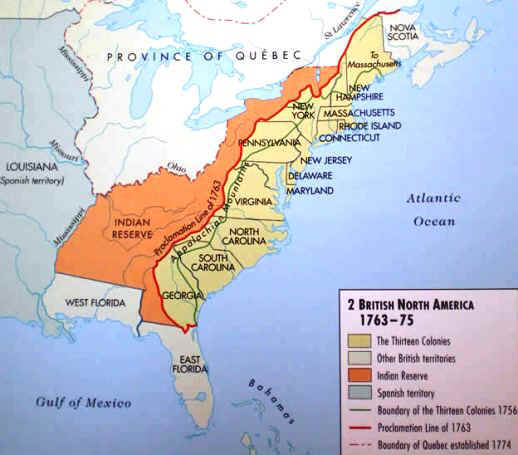
Map British North America 1763 - 1775
Proclamation of 1763
Significance, causes, summary, dates and history of the Proclamation of 1763 for kids
History timeline of the Proclamation of 1763
Interesting Facts and information on the Proclamation of 1763 for kids and schools
Cause and Effects of the Proclamation of 1763
Significance, causes events, summary, dates and history of the Proclamation of 1763 for kids
Proclamation of 1763 - Pictures and Videos of Native Americans
Proclamation of 1763. Discover the the key years, famous people and events of the Proclamation of 1763 together with the causes and effects of the war, conflict and battle. Pictures have been include wherever possible which show the battlefield, clothing and weapons of the Colonial America and their leaders who fought in the Proclamation of 1763. The illustrated text provides a really useful educational resource for kids and children of all ages. We have included pictures and videos to accompany the main topic of this section - The Proclamation of 1763. The videos enable fast access to the images, paintings and pictures together with the information and the many facts featured on this subject of the Proclamation of 1763.
